

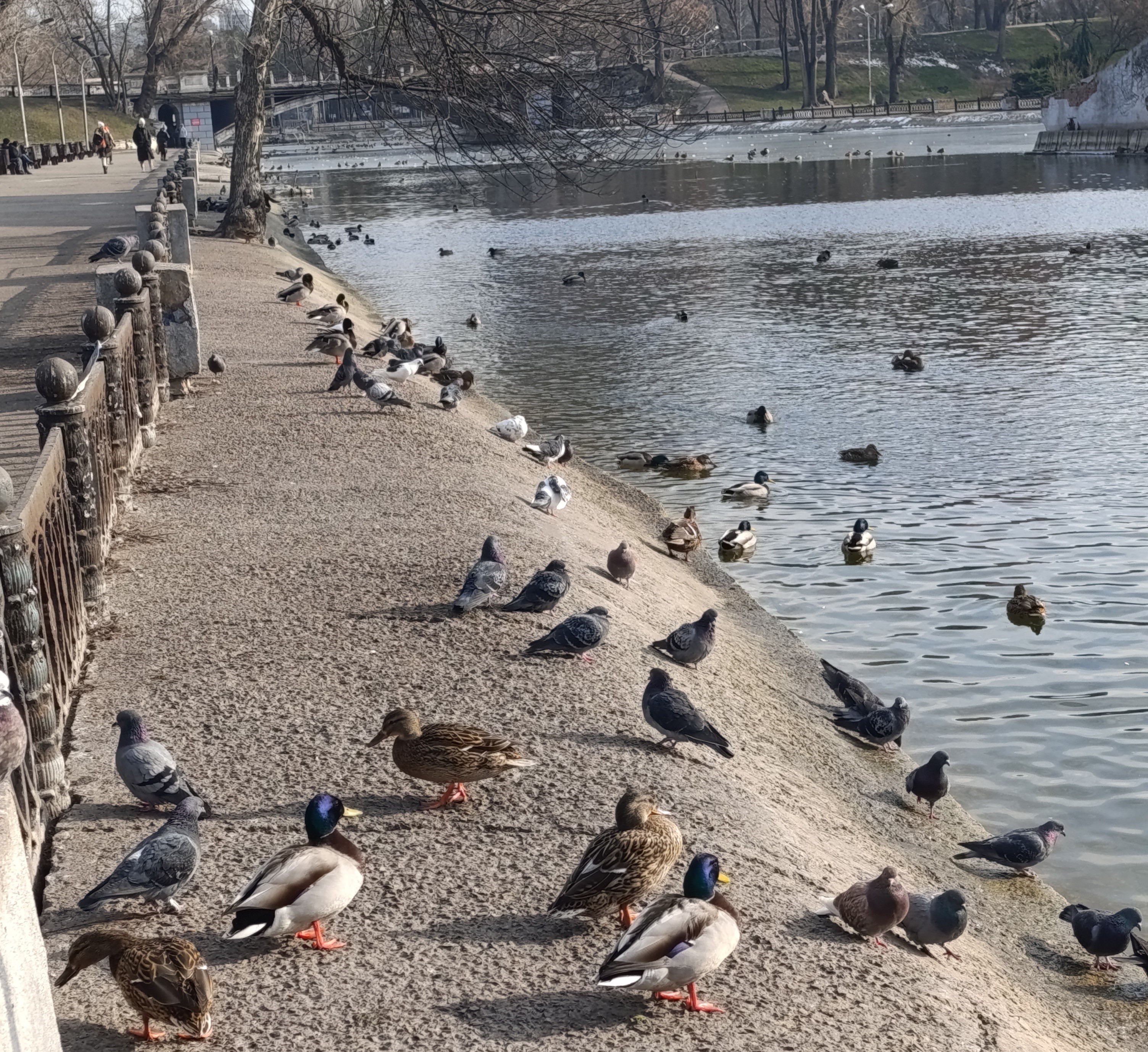
Wintering Mallards quacking, feral Pigeons cooing and briefly a Rook cawing by the lake in Globa Park in the centre of Dnipro. The ducks, though many must have bred in wild locations, are very trusting here and people feed them. This recording represents typical winter sounds in this location without the intrusion of war. Urban sounds, though, intrude in the background; a busy road is 200 metres away.
Крякання зимуючих крижнів, воркування диких голубів і короткочасне каркання грака біля озера в парку Глоби в центрі Дніпра. Качки, хоча багато з них, мабуть, розмножувалися в диких місцях, тут дуже довірливі, і люди їх годують. Цей запис представляє типові зимові звуки в цьому місці без впливу війни. Міські звуки, однак, вклинюються в запис на задньому плані; за 200 метрів знаходиться дорога зі жвавим автомобільним рухом.
Globa Park where I made this recording is in the centre of the city of Dnipro. The lake doesn’t really boast biodiversity. It has concrete banks and it doesn’t have any kind of aquatic vegetation, but it’s very popular with visitors and people like to feed the ducks, although there are notices saying that you should not do so. Now there are practically only Mallards and sometimes Coots. They are wintering here and in mid-winter there could be about 400 Mallards…Thinking about my two recordings together [his other recording captured the sounds of Rooks in Sevastopolski Park, Dnipro], perhaps the general idea could be that in a city that still has a comparatively low intensity of bombardment, and a city that is not yet on the doorstep of the front line, these sounds show a kind of continuity of normal life. And people walking in the parks – whether they are dog walking or walking with children or grandchildren or just relaxing – naturally like to continue life as normal and not torment themselves with thoughts of the war. And perhaps the recordings also highlight a contrast within Ukraine between areas directly under fire and areas, like the city of Dnipro, that are more indirectly affected.
Парк Глоби, де я зробив запис, розташований у центрі міста Дніпро. Озеро не вирізняється особливим біорізноманіттям. Воно має бетонні береги і не має ніякої водної рослинності. Проте воно дуже популярне серед відвідувачів і люди люблять годувати тут качок попри знаки, які забороняють це робити. Зараз тут практично самі лише крижні та інколи трапляються лиски. Вони тут зимують і посеред зими можна нарахувати близько 400 крижнів… Думаючи про обидва мої записи одночасно [інший запис зафіксував крики граків у Севастопольському парку у м. Дніпро], можливо, їх можна об’єднати ідеєю, що в місті, яке все ще має порівняно низьку інтенсивність бомбардувань та обстрілів, і яке ще не знаходиться у безпосередній близькості до лінії фронту, ці звуки демонструють певну безперервність нормального життя. І люди, які відпочивають у парках – гуляють вони з собаками, гуляють з дітьми чи онуками – природно, насолоджуються продовженням свого звичного життя і не мучать себе думками про війну. І, можливо, ці записи також підкреслюють контраст в Україні між територіями, які безпосередньо знаходяться в зоні обстрілів, і територіями, такими як місто Дніпро, які постраждали більш опосередковано.